Union Budget 2025-26: 1.7 Crore Farmers to Benefit from Enhanced Agricultural Productivity, Improved Irrigation, and Easy Credit Access
Program for Rural Prosperity and Resilience to Increase Economic Growth and Agricultural Employment Aatmanirbharta’s 6-Year Mission in Pulses: Climate-Resilient Seeds, Storage, and Equitable Pricing Comprehensive Fruit and Vegetable Program: Improving Supply, Production, and Farmer Income Grameen Credit Score: PSBs to Improve Access to Rural and SHG Credit
Short Info: In March 2025, New Delhi The Prime Minister Dhan-Dhaanya Krishi Yojana (PMDKY) will be launched by the Indian government as part of the Union Budget 2025–2026. The program’s objectives are to increase agricultural output, upgrade irrigation systems, and give farmers in 100 areas with historically low crop yields both short-term and long-term loan help.
Yojana Krishi About 1.7 crore farmers will gain from this revolutionary scheme, which will provide them access to modern agricultural resources, financial support, and improved farming practices. The Union Budget 2025-26 includes several development measures, one of which is to boost agricultural productivity and growth. Smt. Nirmala Sitharaman, the Union Minister of Finance and Corporate Affairs, said during the presentation of the Union Budget 2025–2026 in the Parliament today that agriculture is one of the four strong engines among MSME, investment, and exports. The following are specific recommendations made in the Union Budget to increase agricultural resilience and productivity:
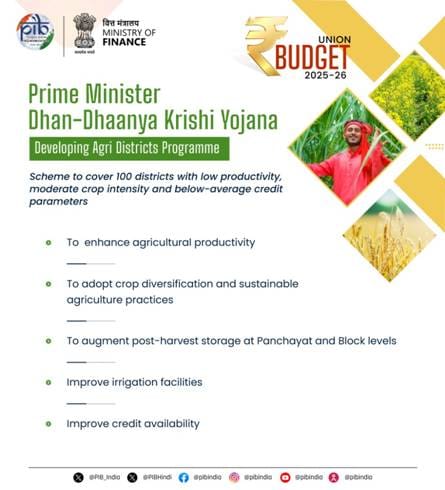
Prime Minister Dhan-Dhaanya Krishi Yojana-Developing Agri Districts Programme
Motivated by the Aspirational Districts Program’s success, the Union Finance Minister announced that the government will launch a “Prime Minister Dhan-Dhaanya” initiative in collaboration with the states. The initiative will cover 100 districts with below-average credit criteria, moderate crop intensity, and low production by combining current programs with specific measures. Enhancing agricultural productivity, implementing crop diversification and sustainable agriculture techniques, increasing post-harvest storage at the panchayat and block levels, improving irrigation infrastructure, and making long-term and short-term financing more accessible are all goals of the program. 1.7 crore farmers are anticipated to benefit from this scheme.
Building Rural Prosperity and Resilience
A comprehensive “Rural Prosperity and Resilience” program that was created in partnership with state governments was announced by the Union Finance Minister. Through the adoption of contemporary technologies, investment encouragement, skill development, and rural economic revitalization, this effort seeks to address underemployment in the agriculture sector. Its main goal is to make migration a choice rather than a necessity by generating plenty of possibilities in rural areas.
The initiative would prioritize the empowerment of marginal and small-scale farmers, young farmers, jobless rural youth, landless households, and rural women. It aims to increase employment, encourage entrepreneurship, and help rural women become financially independent. Additionally, it will boost agricultural output, create better storage and warehousing facilities, particularly for small and marginal farmers, and encourage the establishment of new enterprises and opportunities for young people and young farmers. The program will assist landless families in diversifying their sources of income. The program will use established national and international best practices to guarantee its efficacy. Additionally, it will work with international development institutions to obtain financial and technical assistance. The initiative will be implemented in 100 agri-districts during its initial phase.
Aatmanirbharta in Pulses
In order to achieve atmanirbhrata in edible oils, the government is undertaking the National Mission for Edible Oilseed, Smt. Nirmala Sitharaman emphasized. Through coordinated efforts, the government was able to achieve near-self-sufficiency in pulses. The government made arrangements for procurement and fair prices, and farmers responded by expanding the cultivated area by 50%. Since then, pulse consumption has grown dramatically because to improved affordability and rising earnings. She added that the government would begin a six-year “Mission for
Particular attention is paid to Tur, Urad, and Masoor in “Aatmanirbharta in Pulses.” The mission will focus on developing and commercializing climate-resilient seeds, improving their protein content, raising production, optimizing post-harvest management and storage, and guaranteeing farmers receive fair pricing. As much as is offered by farmers who register with NAFED and NCCF and engage into agreements, these central agencies will be prepared to purchase these three pulses throughout the course of the following four years.
Comprehensive Programme for Vegetables & Fruits
People’s growing awareness of their dietary needs is good, according to the Union Finance Minister. It is an indication that society is getting healthier. The intake of fruits, vegetables, and Shree-Anna is rising dramatically as income levels rise. In collaboration with states, a comprehensive program will be initiated to increase production, efficient supply, processing, and fair prices for farmers. She went on to say that suitable institutional frameworks will be established for the implementation and involvement of cooperatives and farmer-producer organizations.
Grameen Credit Score
According to the Union Finance Minister, Public Sector Banks would create the “Grameen Credit Score” framework to meet the credit requirements of rural residents and SHG members.